
Esterbrook Nib Guide
Esterbrook built its name on nibs before it ever made a fountain pen. In 1858, a Cornish stationer named Richard Esterbrook came to America with a plan — and a handful of the best pen craftsmen Birmingham, England had to offer. Together they built the largest steel pen maker in the country, with a nib for every writing style in America. The modern Esterbrook carries that history forward in the best possible way — with an interchangeable nib system and a menu of options that keeps growing.
If you've ever picked up an Estie and wondered which nib belongs on it, this guide is for you. There's no wrong nib to choose, and there's no wrong way to choose one. But there is probably a nib that fits the way you write, and finding it is half the fun.
The basics

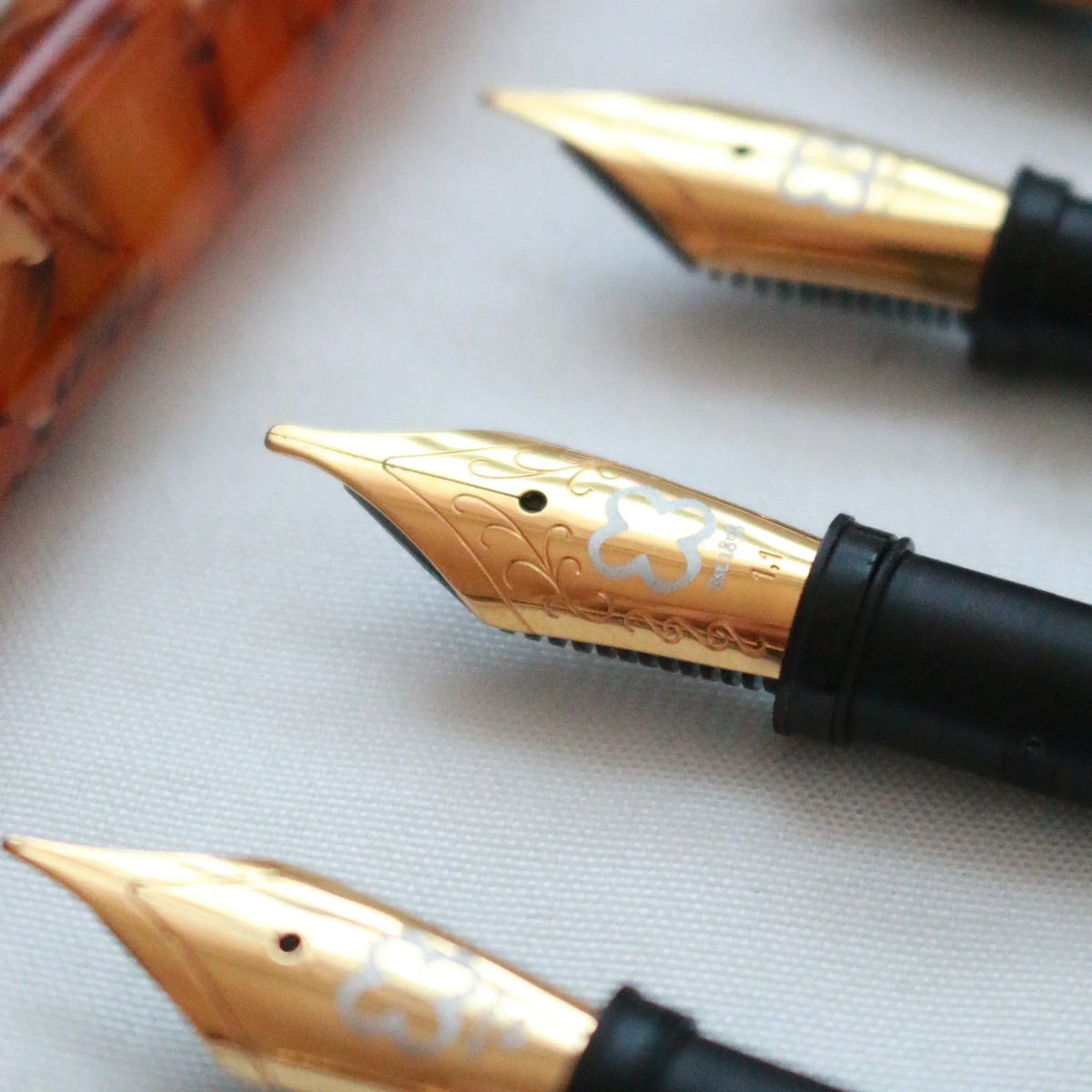
Every modern Esterbrook nib is a #6 steel nib made in Germany by JoWo, one of the most trusted names in the industry. They're known for being smooth and consistent right out of the box, and the same #6 nib runs across the family — from the full-size Estie all the way down to the pocket-sized Niblet, so your nibs move between pens. (The one exception: the Estie JR takes a smaller #5 nib, so JR nibs and Estie nibs don't swap.) Changing nibs is simple: unscrew the old nib unit, screw in the new one. Standard nib units come in gold, palladium, or black trim to match your pen and start at $25, which makes trying a new size a fairly low-stakes adventure.
The standard lineup
Esterbrook offers extra-fine, fine, medium, and broad as standard nibs, plus a 1.1 stub — and any of them can come on your pen at no extra cost. (Some models add a double broad to the menu, and a specialty fude nib has joined the family on certain pens too.)
Extra-fine and fine are the precision nibs. They put down a crisp, controlled line with just a little bounce, so you never feel like you're writing with a nail. If you live in a planner or write small, start here. They also dry faster, which left-handed writers will appreciate.
Medium is where ink starts to show off. You get more shading, a smoother glide, and a line that's comfortable for long journaling sessions or letters. If you're not sure where to start, medium is the friendly middle of the menu.
Broad is the wettest and smoothest of the bunch. It lays down enough ink to show every bit of sheen and shading a fancy ink can offer, and it makes a signature look like an event. It does drink ink and prefers good paper, so treat it accordingly.
The 1.1 stub has a flattened tip that gives you broad downstrokes and thin cross strokes — instant flair without learning calligraphy. There's a small learning curve while you find the angle, so if your first line feels catchy, don't give up. Once it clicks, it's addictive.
The flex nibs
Esterbrook also offers extra-fine flex and fine flex nibs, with little cutouts in the steel that let the tines bend for line variation. They come at no extra charge when ordered on a new pen, or about $50 as a separate unit. Two honest notes from the community: the flex sizes run wide (the extra-fine flex writes closer to a medium), and you'll need deliberate pressure to get the variation — this is steel flex, not a vintage wet noodle. The upside is that steel is forgiving. You can play with flexy writing without worrying about springing an expensive gold nib.
The custom grinds
This is where Esterbrook does something almost nobody else does at this price. They partner with well-known nibmeisters — the people you'd normally wait in line for at a pen show — and offer their hand-ground specialty nibs as an option on a new pen, for an upcharge that reflects the handwork (typically $60–75 over the standard nib). Four grinds are in the program right now.
The Journaler, by Gena Salorino
A medium nib ground to a stub, based on the vintage Esterbrook 9314M, by Gena Salorino of Custom Nib Studio. It's meant to be smooth and friendly enough for everyday use while giving your writing some flair — and that's exactly how it feels. It's far more forgiving than a traditional stub. If the pen community has a favorite Esterbrook nib, this is it; ask around and you'll hear "the Journaler, hands down" more than once.
The Scribe, by Josh Lax
An architect grind — think of it as a reverse stub, with broad cross strokes and thin downstrokes — from New York nibmeister Josh Lax, inspired by vintage Esterbrook Relief nibs. It makes printing look neater with no extra effort, which feels a little like cheating. One thing to know: architect grinds have a sweet spot, and the Scribe likes a lower writing angle than some of us naturally use. Give yourself time to find it.
The Needlepoint, by Kirk Speer
Ever tried an extra-fine and thought, still too big? Kirk Speer of Pen Realm grinds this one from a fine nib down to an ultra-fine point, and reviewers consistently call it smoother than nearly any other needlepoint out there. It's the nib for tiny planner grids, margin notes, and small handwriting, and it behaves surprisingly well on cheap paper because it puts down so little ink. Just keep the shimmer inks away from it.
The Techo, by CY of Tokyo Station Pens

The newest of the group, designed as an all-in-one travel nib. Hold the pen low and you get a thicker line; hold it high and the line thins out. One nib, a whole range of lines — great for journaling and sketching away from your desk.
The ones that are hard to find
Here's the catch with the custom grinds: each one is ground by hand, so they're made in small batches. They're most often offered as an option when you buy a new pen, and while separate nib units do surface from time to time, they go out of stock quickly — sometimes for a while — and some retailers stop carrying certain grinds altogether. If you see the one you want on the pen you want, that's the moment.
Quick answers
Are Esterbrook nibs interchangeable?
Yes. Every modern Esterbrook uses a screw-in #6 JoWo steel nib unit, so nibs swap freely between the Estie, the Estie Oversized, and the Niblet. The one exception is the Estie JR, which takes a smaller #5 nib.
What nib sizes does the Esterbrook Estie come in?
Extra-fine, fine, medium, broad, and a 1.1 stub come standard at no extra cost, with extra-fine flex and fine flex also available. Four hand-ground custom nibs — the Journaler, Scribe, Needlepoint, and Techo — can be added to a new pen for an upcharge.
What is the Journaler nib?
The Journaler is a medium nib ground into a smooth, forgiving stub by nibmeister Gena Salorino of Custom Nib Studio, based on the vintage Esterbrook 9314M. It adds flair to everyday handwriting without the learning curve of a traditional stub.
Which Esterbrook nib is best for small handwriting?
Start with extra-fine or fine. If those still feel too wide, the Needlepoint — ground by Kirk Speer of Pen Realm — puts down an ultra-fine line that's perfect for planner grids and margin notes.
So which nib is yours?
Think about how you actually write. Small and precise? Extra-fine, fine, or the Needlepoint. Long journal entries? Medium, broad, or the Journaler. Want flair without effort? The Journaler or the Scribe. Want to play? Flex or the Techo. It's not about finding the objectively best nib — it's about finding the one that makes you want to keep writing.
We'd love to help you figure it out. Come see which Esterbrook pens and nibs we have in the shop right now — and if you don't see what you're looking for, send us a note. We have a talent for making the right combination happen and talking through nibs is one of our favorite things to do.